The Florida Department of Health in Okaloosa County (DOH-Okaloosa) participates in the Healthy Beaches Monitoring Program to collect water samples on a bi-weekly basis from March through October.
The goal of the program is to prevent waterborne illness by advising Okaloosa residents and visitors against recreating in waters potentially contaminated with human pathogens.
Testing is conducted to determine the level of enteric bacteria (enterococci) in the water. Enteric bacteria are bacteria that normally inhabit the intestinal tract of humans and animals. The presence of enteric bacteria is an indication of fecal pollution, which may come from storm water runoff, pets, wildlife and human sewage. If these bacteria are present in high concentrations in recreational waters and they are ingested while swimming or enter the skin through a cut or sore, they may cause human disease, infections, or rashes.
Depending on the bacteria levels, a health advisory may be issued, and posted signs are used to advise the community and tourists.
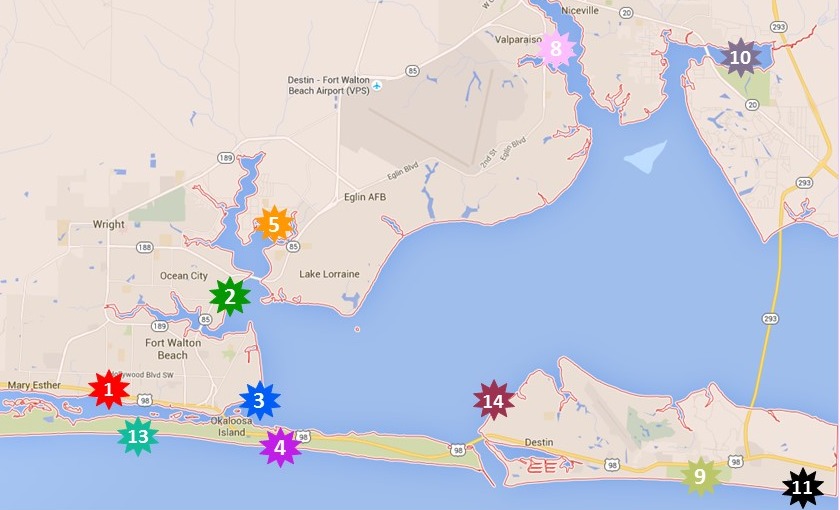
Testing Locations
Site selection along our local beaches considered the number of people that use the beach and the potential of being impacted by nearby pollution sources (such as stormwater or wastewater outfalls, septic tanks, etc.).
- 1 – Liza Jackson Park: 338 Miracle Strip Parkway SW, Fort Walton Beach
- 2 – Garniers Park: 257A Beachview Drive NE, Fort Walton Beach
- 3 – Marler Park: 1275 Santa Rosa Blvd., Okaloosa Island
- 4 – Wayside Park: 1460 Miracle Strip Parkway, Okaloosa Island
- 5 – Poquito Bayou: 4 Bay St., Shalimar
- 8 – Lincoln Park: N Bayshore Drive, Valparaiso
- 9 – Henderson Beach State Park: Henderson Beach Road, Destin
- 10 – Fred Gannon/Rocky Bayou State Park: 4281 Hwy 20, Niceville
- 11 – James Lee Park: 3510 Scenic Hwy 98, Destin
- 13 – Emerald Promenade: 900 Santa Rosa Blvd., Fort Walton Beach
- 14 – Taylor Park: 131 Calhoun Ave., Destin
Environmental public health specialists test the waters of 11 Okaloosa County beaches.
Frequently Asked Questions
What is the Healthy Beaches program?
Coastal beach water samples are collected every other week from designated public beaches in Okaloosa County from March to October. Results are shared via press release no later than Thursday of the sampling week. The samples are analyzed for enterococci bacteria.
High concentrations of these bacteria may indicate the presence of microorganisms that could cause disease, infections, or rashes.
The Florida Department of Health issues health advisories when enterococci levels exceed the acceptable level at the time of the sample collection.
What causes the health department to issue an advisory?
Swimming in natural waterbodies is always at your own risk, regardless of whether or not an advisory is issued. If the Florida Department of Health has issued an advisory, it is because enterococci bacteria have exceeded the acceptable level at the time of bi-weekly sampling.
How are the water quality results of Good, Moderate, and Poor defined?
The following water quality classifications are used by the Florida Department of Health and are based upon U.S. Environmental Protection Agency’s recommended standard for enterococci. The classification standard is:
- Good: 0-35 colony forming units (CFU) per 100 milliliters (ml) of marine water
- Moderate: 36-70 CFU per 100 ml of marine water
- Poor: greater than 70 CFU per 100 ml of marine water
Healthy Beaches test results are a reflection of a water sample taken at a point in time. As such, bacteria levels may change between testing periods. Significant rainfall with stormwater runoff between testing periods may result in elevated levels of enterococci bacteria in the water.
What are enterococci?
Enterococci are bacteria found in the intestines of all warm-blooded animals, including humans. Because these bacteria are easy to detect and commonly found in animal and human waste, they are used as indicators of recreational water quality conditions.
Enterococci are the organisms that the U.S. Environmental Protection Agency recommends using to measure bacteria levels in recreational water.
Can I swim or wade in the water when an advisory is posted?
That is your personal decision. The Florida Department of Health is advising you to not enter the water if the beach is under an advisory. There is a risk of illness from contacting beach water with elevated bacteria levels by ingesting water; by getting water in the nose, eyes, and ears, or by water making contact with an open wound.
For the vast majority of people, the risk of serious illness is minimal. An otherwise healthy person may have no problems with contact with the water of a beach that is under advisory. Some may experience a minor inflammation of a cut, a mild sore throat or mild diarrhea after exposure to water from a beach under advisory.
The greatest risk is for very young children, the elderly and people who have compromised immune systems since their ability to fight off infection is limited by age or disease.